

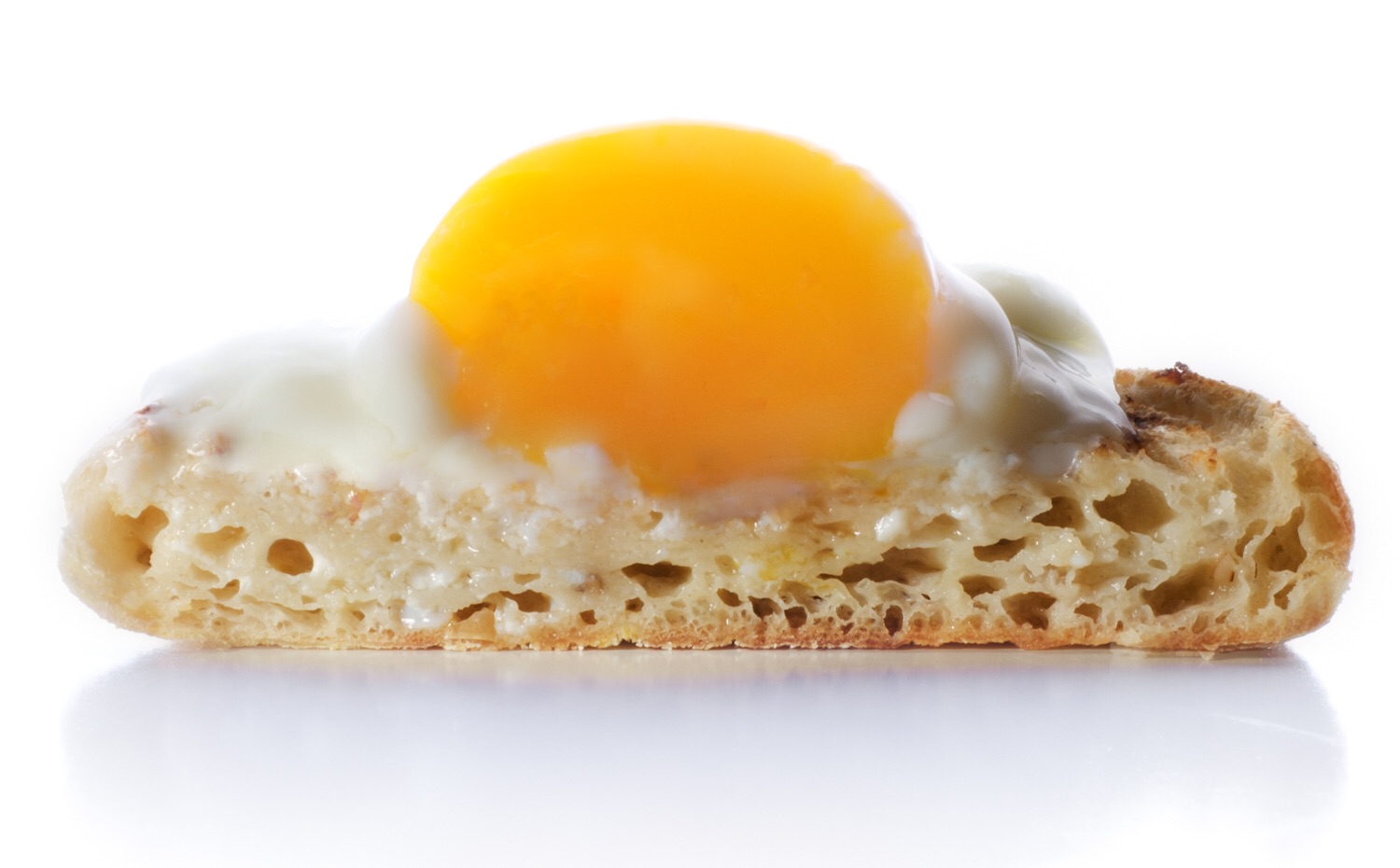

There are few things lovelier than a perfectly poached egg. The way a thick, flavorful yolk, and tender egg white coat a dish in a naturally savory sauce is a beautiful thing.
Creating a well-made poached egg—a fundamental technique that often eludes even the finest cooks—became infinitely easier, and perhaps even foolproof, with the rise of sous vide cooking. No more confusion over whether to stir the water; how to drop the egg into the pot; or how to remove it properly. Now, we need only to accurately measure time and temperature to ensure a perfect product.
We cook a 57 g egg (extra large) at a high temperature (167 °F / 75 °C) for a short amount of time (13 minutes), rather than at equilibrium temp for longer, to create a firm egg white that’s very similar to a traditionally poached egg. We find that cooking the eggs at a lower temp for longer leaves us with overly runny whites; not our preferred texture. In fact, several other chefs such as Alex Talbot and Aki Kamozawa at Ideas in Food There are few things lovelier than a perfectly poached egg. The way a thick, flavorful yolk, and tender egg white coat a dish in a naturally savory sauce is a beautiful thing.
Creating a well-made poached egg—a fundamental technique that often eludes even the finest cooks—became infinitely easier, and perhaps even foolproof, with the rise of sous vide cooking. No more confusion over whether to stir the water; how to drop the egg into the pot; or how to remove it properly. Now, we need only to accurately measure time and temperature to ensure a perfect product.
We cook a 57 g egg (extra large) at a high temperature (167 °F / 75 °C) for a short amount of time (13 minutes), rather than at equilibrium temp for longer, to create a firm egg white that’s very similar to a traditionally poached egg. We find that cooking the eggs at a lower temp for longer leaves us with overly runny whites; not our preferred texture. In fact, several other chefs such as Alex Talbot and Aki Kamozawa at Ideas in Food have a similar preference and independently developed the same technique.
But the beauty is this: With sous vide, you can play with different times and temperatures to produce nearly any desired outcome. Whether you like your eggs runny, firm, thick, or hard-boiled, sous vide gets the job done. And with little mess: just cook the egg in its own shell!
Ingredients
1 extra large egg
Preparation
- Heat water bath to 167 °F / 75 °C
- Place fridge-temperature egg in a 167 °F / 75 °C water bath, and cook for 13 minutes.
Serve or store
- Immediately serve the egg or shock in ice water and reserve in the refrigerator until needed.
- To reheat a chilled 75 °C egg, place in a 145 °F / 63 °C bath for 15 minutes.
Cooks Note
This recipe works best for extra large eggs, which are usually about 64 g each.
For easier removal of several eggs, you can cook them in a zip-lock bag. To do this, attach the bag to the side of the bath by using a clip, or by simply resting the lid on top of the bag.
If you’re using room temperature eggs, the cooking time will be slightly less.

Leave a Reply