
Precision-temperature fresh cheesemaking with the Breville Control °Freak™
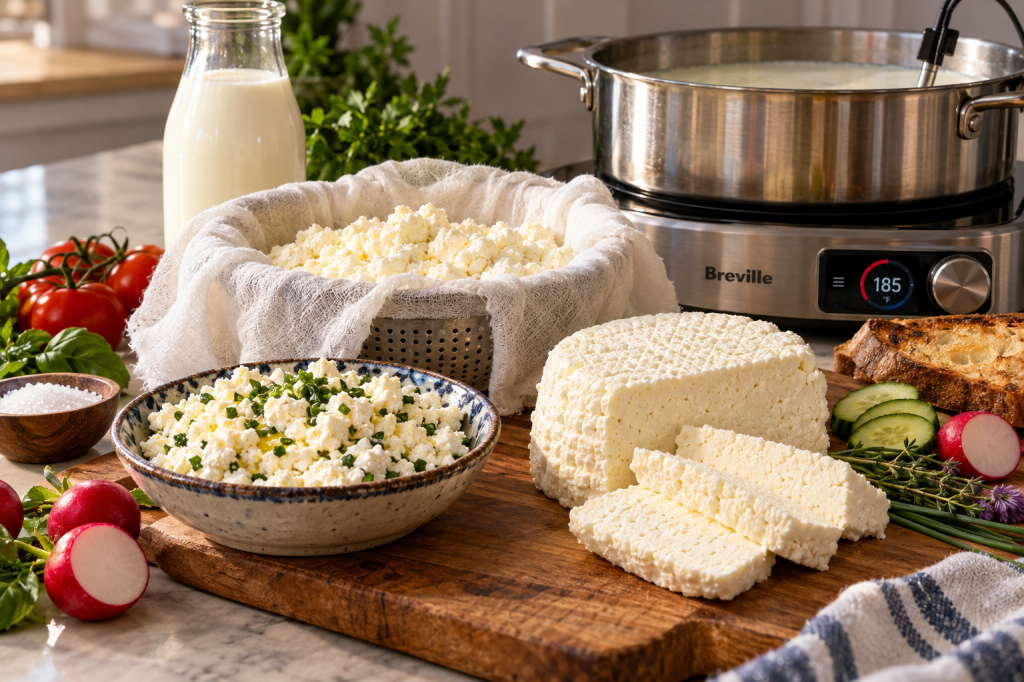
Homemade farmer’s cheese becomes remarkably simple with the precision temperature control of the Breville Control °Freak™. By monitoring the milk directly with its temperature probe, this method removes much of the guesswork associated with traditional stovetop cheesemaking. Gentle heating, carefully controlled acidification, and minimal handling produce delicate, tender curds with a clean, naturally sweet dairy flavor. Enjoy the finished cheese soft and spreadable, gently drained and crumbly, or pressed into a firm, sliceable cheese suitable for salads and light pan-searing.
With just three ingredients, this recipe combines traditional fresh cheesemaking with modern temperature precision for consistently excellent results.
Servings: Approximately 12–20 ounces, depending on moisture retained
Prep Time: 10 minutes
Cook Time: 25–40 minutes
Total Time: 55–85 minutes for soft cheese; up to 3 hours for pressed cheese
Difficulty: Level 2 Easy
Cost: Level 2 Economical
Region / Ethnic Origin: International; traditional acid-set fresh cheesemaking
Ingredients
Fresh Farmer’s Cheese
- 1 gallon fresh, pasteurized whole milk, preferably nonhomogenized, not ultra-pasteurized
- 1/4 cup distilled white vinegar (5% acidity), plus up to 2 tablespoons additional vinegar if needed
- 1/2 teaspoon fine sea salt, or approximately 0.8–1% of the drained cheese weight, adjusted to taste
Optional Flavor Enhancements
- 1 tablespoon finely chopped fresh chives
- 1 teaspoon finely chopped fresh thyme
- 1/4 teaspoon freshly ground black pepper
- 1 teaspoon finely grated lemon zest
Equipment
- Breville Control °Freak™ precision induction cooker with temperature probe
- Large, heavy-bottomed, induction-compatible stainless steel stockpot
- Silicone spatula
- Fine butter muslin or tightly woven cheesecloth
- Large colander and collecting bowl
- Slotted spoon or fine skimmer
- Digital kitchen scale
- Optional perforated cheese mold, follower, and 2–4 pounds of weight for pressing
Instructions
Prepare the Equipment
- Thoroughly wash and sanitize the stockpot, temperature probe, colander, skimmer, and any other equipment that will contact the milk or cheese.
- Line a large colander with clean butter muslin or several layers of tightly woven cheesecloth. Place it over a large bowl to collect the whey.
- Measure the vinegar into a small bowl. Keep the additional vinegar nearby in case the milk requires more acid to separate completely.
Configure the Control °Freak™
- Place the stockpot on the Control °Freak™ and pour in the milk.
- Secure the temperature probe to the side of the pot, positioning the sensing tip fully beneath the milk surface without touching the bottom or sides.
- Select the water-based Probe Control mode and set the target temperature to 185°F. Begin with medium heating intensity.
- Heat the milk gradually, stirring gently every few minutes with a silicone spatula. Sweep the bottom of the pot to prevent milk solids from adhering or scorching.
- When the milk reaches approximately 175–180°F, reduce the heating intensity to Slow if necessary to minimize temperature overshoot.
- Continue heating until the probe reads 185°F. Stir gently to distribute the heat evenly, then verify that the milk temperature has stabilized near the target.
Form the Curds
- Turn off the Control °Freak™. Leave the pot in place if convenient, but ensure that heating has stopped.
- Add approximately one-third of the measured vinegar, stirring with two or three slow strokes.
- Add the second third of the vinegar, again stirring gently.
- Gradually add the remaining vinegar, stopping when distinct white curds begin separating from the translucent yellow-green whey.
- If the whey remains opaque and milky, add additional vinegar 1 teaspoon at a time, stirring gently after each addition. Allow 1–2 minutes between additions to observe the separation. Avoid adding more acid than necessary.
- Cover the pot and allow the curds to rest undisturbed for 15 minutes with the heat off.
Drain the Cheese
- Carefully lift the curds from the whey using a slotted spoon or fine skimmer. Transfer them gently to the prepared cheesecloth-lined colander.
- Allow the curds to drain naturally without squeezing or excessive stirring.
- Select the desired finished texture:
- Soft and creamy: Drain approximately 10–15 minutes, until moist and spreadable.
- Tender and crumbly: Drain approximately 20–30 minutes, until the curds hold their shape but remain delicate.
- Firm and sliceable: Drain approximately 30 minutes, then proceed with the pressing instructions below.
- Reserve several tablespoons of whey before discarding or storing the remainder. The reserved whey may be used to adjust the moisture of soft cheese if necessary.
Season the Cheese
- Transfer the drained curds to a clean bowl and sprinkle with 1/2 teaspoon fine sea salt.
- Fold gently to distribute the salt without breaking the curds excessively. Taste and adjust the seasoning.
- For greater precision, weigh the drained cheese and use approximately 0.8–1% salt by weight as a starting point. For example, 400 grams of cheese would require approximately 3.2–4 grams of salt.
- If preparing a flavored version, gently fold in the selected herbs, black pepper, or lemon zest.
Optional: Press for a Firm, Sliceable Cheese
- Transfer the drained, seasoned curds to a perforated cheese mold lined with clean butter muslin.
- Fold the muslin over the surface of the cheese and position a flat follower on top.
- Apply approximately 2–4 pounds of evenly distributed weight.
- Place the mold in a covered, food-safe container in the refrigerator, allowing whey to drain away from the cheese.
- Press for 1–2 hours, checking the firmness after the first hour. The finished cheese should be cohesive and firm enough to slice without excessive crumbling.
- Carefully remove the cheese from the mold, unwrap, and refrigerate until ready to serve.
Cook’s Notes
- Why use the Control °Freak™: Probe Control measures the temperature of the milk directly rather than relying solely on the temperature of the cookware. This provides more consistent heating and reduces the risk of temperature overshoot.
- Probe placement: Keep the sensing tip submerged in the milk without touching the pot. Contact with the metal can produce misleading temperature readings.
- Heating intensity: Medium intensity is suitable for the initial heating stage. Reducing to Slow near the target temperature provides gentler control and helps prevent overshooting.
- Stirring remains important: Although the Control °Freak™ regulates temperature, it does not eliminate the possibility of localized heating or milk solids adhering to the pot. Gentle, periodic stirring is still necessary.
- Milk selection: Fresh, pasteurized whole milk produces dependable results. Nonhomogenized milk is an excellent choice, but ordinary pasteurized whole milk also works. Avoid ultra-pasteurized milk.
- Why vinegar is preferred: Distilled white vinegar has standardized acidity, producing more consistent results than fresh lemon juice. Its relatively neutral flavor allows the milk’s natural sweetness to remain prominent.
- Lemon juice substitution: Replace the vinegar with approximately 1/4 cup strained fresh lemon juice, adding more gradually if needed. The finished cheese will have a slightly brighter flavor.
- Avoid excessive acid: Stop adding vinegar once substantial curds have formed and the whey has become translucent. Too much acid can make the cheese unnecessarily sour.
- Protect the curds: Minimal stirring after acidification preserves larger, more tender curds and reduces losses during draining.
- Salt by weight: Weighing the drained cheese provides the most consistent seasoning. Approximately 0.8–1% salt by weight is a useful starting point.
- Adjusting moisture: If the soft cheese becomes slightly too dry, gently fold in a teaspoon or two of reserved whey until the desired consistency is restored.
- Expected yield: One gallon of whole milk may produce approximately 12–20 ounces of cheese, depending on the milk and the amount of moisture retained. Actual yield will vary.
- Pressed cheese: The firm version is suitable for slicing and gentle pan-searing, although its exact cooking behavior depends on moisture and curd structure. It will not melt like mozzarella or cheddar.
Troubleshooting
- Milk does not separate: Confirm that the milk reached 185°F and is not ultra-pasteurized. Add additional vinegar gradually, allowing time for the curds to develop.
- Whey remains cloudy: Some fine milk solids may remain suspended even after successful coagulation. If substantial curds have formed, avoid adding unnecessary acid.
- Cheese tastes sour: Excessive vinegar may have been added. Use only enough acid to achieve separation and avoid prolonged contact with the acidic whey.
- Cheese is dry or rubbery: The milk may have been overheated, the curds overhandled, or the cheese drained too long. Reduce draining time and handle the curds more gently in the next batch.
- Pressed cheese crumbles when sliced: The curds may have been too dry or insufficiently consolidated. Press slightly moister curds and ensure the weight is distributed evenly.
Serving Suggestions
- Classic breakfast: Spread soft farmer’s cheese over toasted sourdough or warm biscuits, finished with honey, preserves, or fresh berries.
- French omelette: Serve a spoonful alongside or inside a Classic French Omelette for a delicate, creamy breakfast.
- Fresh vegetable platter: Pair with sliced tomatoes, cucumbers, radishes, roasted peppers, and extra-virgin olive oil.
- Seasonal salads: Crumble the tender cheese over mixed greens, roasted beets, or fresh tomatoes.
- Warm pressed cheese: Lightly sear slices of the firm cheese in a well-seasoned skillet with a small amount of olive oil. Serve immediately with roasted vegetables or a fresh herb salad.
- Sweet presentation: Spoon soft cheese into a shallow serving bowl, drizzle with honey, and finish with toasted pecans and fresh figs.
Beverage Suggestions
- Agave Lemonade: The refreshing citrus flavor of Agave Lemonade provides a bright contrast to the rich, creamy cheese.
- Freshly brewed coffee: Medium-roast coffee pairs particularly well with the cheese when served on toast or alongside breakfast pastries.
- Hot black tea: Earl Grey or English breakfast tea complements both sweet and savory presentations.
- Sparkling water: Serve chilled with fresh lemon or cucumber for a clean, refreshing accompaniment.
Storage and Reheating
- Refrigeration: Transfer the finished cheese to a clean, airtight container and refrigerate promptly at 40°F or below. For best quality and safety, consume within 3–4 days.
- Pressed cheese: Wrap in clean parchment paper and place inside a covered container. Refrigerate and use within 3–4 days.
- Freezing: Not recommended for the soft version because freezing can produce a grainy texture and moisture separation. Pressed cheese may also become crumbly after thawing.
- Reheating: Soft cheese is best served chilled or slightly cool. Pressed cheese may be gently pan-seared, but avoid prolonged high heat.
- Food safety: Use pasteurized milk and thoroughly cleaned equipment. Refrigerate the curds promptly during extended draining or pressing, and never leave the finished cheese at room temperature for more than 2 hours.
Variations
- Lemon Farmer’s Cheese: Substitute strained fresh lemon juice for the vinegar. Add finely grated lemon zest after draining for a delicate citrus aroma.
- Garlic and Herb Farmer’s Cheese: Fold finely chopped chives, thyme, and a small amount of roasted garlic into the soft cheese.
- Cracked Pepper Farmer’s Cheese: Add freshly ground black pepper and a little lemon zest for a savory spread.
- Honey and Vanilla Breakfast Cheese: Reduce the salt to 1/4 teaspoon and fold in 1 tablespoon honey and 1/4 teaspoon pure vanilla extract after draining.
- Extra-Creamy Farmer’s Cheese: Replace 1 cup of the whole milk with 1 cup heavy cream. This produces a richer cheese best suited to spreading rather than firm pressing.


Leave a Reply