

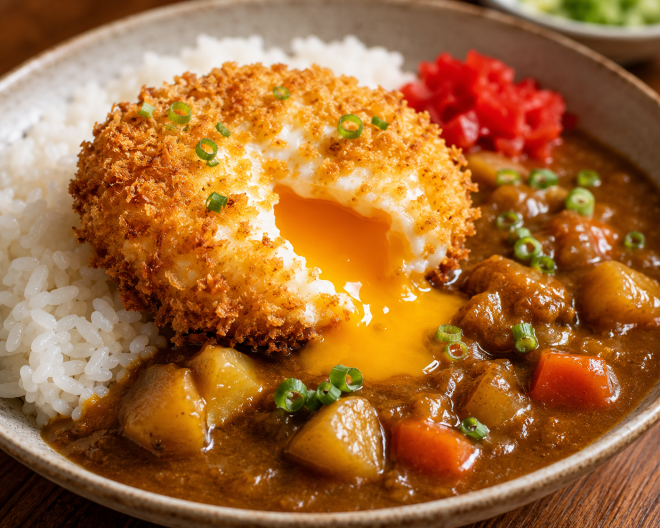
A rich, savory-sweet Japanese curry served over steamed short-grain rice and topped with a crisp panko-coated fried egg. The contrast is the whole point: crunchy breadcrumbs, a soft or runny yolk, tender potatoes and carrots, and a silky curry sauce underneath.
This version builds the curry from scratch for deeper flavor while keeping the panko egg technique that makes the dish special.
Ingredients
For the Japanese Curry
- 2 tablespoons Unsalted Butter
- 1 tablespoon Vegetable Oil
- 1 large Yellow Onion, thinly sliced
- 1 teaspoon Tomato Paste
- 3 cloves Garlic, minced
- 1 tablespoon Fresh Ginger, finely grated
- 2 tablespoons All-Purpose Flour
- 2 tablespoons Japanese Curry Powder
- 1 teaspoon Garam Masala
- 2 3/4 cups Chicken Stock or Vegetable Stock
- 1 tablespoon Soy Sauce
- 1 tablespoon Worcestershire Sauce
- 1 tablespoon Ketchup
- 2 teaspoons Honey
- 1/4 small Apple, peeled and finely grated
- 2 medium Yukon Gold Potatoes, peeled and cut into 3/4-inch pieces
- 2 medium Carrots, peeled and cut into 1/2-inch pieces
- 1/2 teaspoon Kosher Salt, plus more to taste
- 1/4 teaspoon Freshly Ground Black Pepper
- 1 teaspoon Rice Vinegar
For the Crispy Panko Eggs
- 4 large Eggs
- 1 1/4 cups Panko Breadcrumbs
- 1/2 teaspoon Kosher Salt
- 1/4 teaspoon Ground White Pepper
- Vegetable Oil, for frying
For Serving
- 4 cups cooked Japanese Short-Grain Rice
- 2 Green Onions, thinly sliced
- Fukujinzuke, Pickled Ginger, or Quick-Pickled Cucumber, optional
Instructions
Make the Curry
- Heat the butter and vegetable oil in a large saucepan or Dutch oven over medium heat.
- Add the onion and cook for 8–10 minutes, stirring occasionally, until softened and beginning to turn golden.
- Add the tomato paste and cook for about 1 minute, stirring constantly, until it darkens slightly and begins to caramelize.
- Add the garlic and ginger and cook for about 30 seconds, just until fragrant.
- Sprinkle in the flour, curry powder, and garam masala. Cook for 1–2 minutes, stirring constantly, until fragrant and the mixture forms a thick paste.
- Slowly add the stock, stirring continuously to prevent lumps.
- Stir in the soy sauce, Worcestershire sauce, ketchup, honey, and grated apple.
- Add the potatoes, carrots, salt, and black pepper.
- Bring to a gentle simmer. Reduce the heat to medium-low and cook uncovered for 18–25 minutes, stirring occasionally, until the vegetables are tender and the curry has thickened.
- The finished sauce should coat the back of a spoon and slowly run off rather than pour like broth.
- Stir in the rice vinegar.
- Taste and adjust the salt or curry seasoning as needed. Keep warm over very low heat while preparing the eggs.
Prepare the Panko Eggs
- Combine the panko, salt, and white pepper in a shallow dish.
- Cut 4 squares of high-heat parchment paper approximately 6 inches across.
- Place each parchment square on a plate or work surface.
- Place approximately 2 tablespoons of seasoned panko in the center of each piece of parchment and gently spread it into a circle slightly larger than an egg.
- Carefully crack 1 egg directly onto each panko bed.
- Gently cover each egg with approximately 3 tablespoons of additional panko, taking care not to break the yolk.
- Allow the breaded eggs to rest for about 5 minutes so the egg white can moisten the breadcrumbs and help the coating adhere.
Fry the Eggs
- Pour approximately 1 1/2–2 inches of vegetable oil into a deep skillet or saucepan.
- Heat the oil to 350°F.
- Working with 1 egg at a time, carefully lower the parchment paper and egg into the hot oil.
- Fry for 45–60 seconds, until the underside begins to set.
- Using tongs, carefully pull the parchment paper away from beneath the egg.
- Continue frying for approximately 30 seconds.
- Carefully turn the egg and fry for another 30–45 seconds, until the panko is crisp and golden and the yolk remains soft.
- Transfer the egg to a wire rack to drain.
- Repeat with the remaining eggs, allowing the oil to return to 350°F between batches.
To Serve
Divide the hot rice among 4 shallow bowls.
Spoon the Japanese curry generously alongside and partially over the rice.
Place 1 crispy panko egg on top of each serving.
Garnish with sliced green onions and serve with fukujinzuke, pickled ginger, or quick-pickled cucumber.
Cut into the egg immediately before eating so the yolk runs into the curry.
Cook’s Notes
- Oil temperature matters. Keep the oil as close to 350°F as possible. Cooler oil can make the coating greasy, while hotter oil can overcook the yolk before the panko browns.
- A wire rack is preferable to paper towels because it allows steam to escape and helps keep the panko crisp.
- Panko breadcrumbs give a lighter, crunchier coating than ordinary breadcrumbs.
- Grated apple and honey provide the subtle sweetness characteristic of Japanese curry without making the sauce overly sweet.
- Rice vinegar added at the end brightens the curry and balances its richness.
- If the curry becomes too thick, add a small splash of stock until it returns to a smooth, spoon-coating consistency.
- The curry can be made 1 day in advance and reheated gently before serving.
- Fry the eggs immediately before serving so the coating stays crisp.
Serving Suggestions
Serve with a simple cucumber salad, sesame-dressed cabbage, or lightly dressed greens to provide freshness against the rich curry.
For a more traditional accompaniment, add fukujinzuke, the sweet-tart Japanese pickles commonly served with curry rice.
Beverage Suggestions
A crisp Japanese lager pairs particularly well with the fried panko coating and rich curry.
For a nonalcoholic option, serve chilled jasmine tea, roasted barley tea, or unsweetened iced green tea.


Leave a Reply