
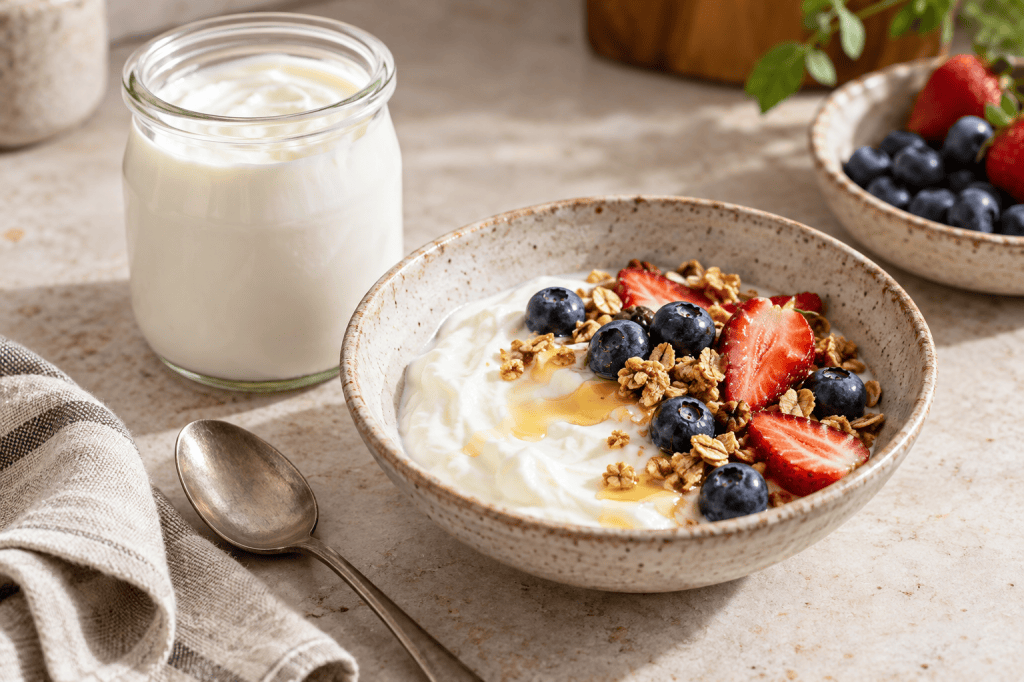
Homemade sous vide yogurt is smooth, creamy, and remarkably simple to prepare. Heating the milk first improves the yogurt’s texture, while the precisely controlled water bath provides the steady warmth needed for the live cultures to work. Incubate it for as little as 5 hours for mild yogurt or longer for a progressively tangier flavor.
Yield: About 3 1/2 cups
Preparation Time: 15 minutes
Incubation Time: 5 to 24 hours
Chilling Time: At least 8 hours
Ingredients
- 3 1/2 cups whole milk
- 2 1/2 tablespoons plain yogurt containing live active cultures
Equipment
- Sous vide immersion circulator
- Large pot or heat-safe container
- 1-quart canning jar with lid, or several smaller jars
- Medium saucepan
- Digital thermometer
- Whisk
- Ice and cold water, optional
Instructions
- Fill a large pot or heat-safe container with enough water to surround the filled jar without covering its lid. Attach the sous vide circulator and set the temperature to 110 degrees Fahrenheit.
- Pour the milk into a medium saucepan. Heat it slowly over low to medium-low heat, stirring frequently and scraping the bottom of the saucepan to prevent scorching.
- Continue heating until the milk reaches 180 degrees Fahrenheit. Remove the saucepan from the heat.
- Allow the milk to cool to between 108 and 112 degrees Fahrenheit. To cool it more quickly, place the saucepan in a bowl of ice water and stir gently. Do not add the yogurt while the milk is hotter than 115 degrees Fahrenheit because excessive heat may damage the live cultures.
- Place the plain yogurt in a small bowl. Add about 1/2 cup of the warm milk and whisk until completely smooth.
- Pour the yogurt mixture back into the remaining milk and whisk gently until evenly combined. Avoid vigorous whisking that creates excessive foam.
- Transfer the mixture to a clean 1-quart canning jar or divide it among several smaller jars. Secure the lids until comfortably snug, but do not overtighten them.
- Carefully lower the jar or jars into the preheated water bath. The water should reach approximately the level of the yogurt without covering the lids.
- Incubate at 110 degrees Fahrenheit until the yogurt reaches the desired flavor:
- 5 to 8 hours: Mild and gently tangy
- 10 to 12 hours: Firm with a balanced tartness
- 18 to 24 hours: Pronounced tang and a more assertive cultured flavor
- Remove the jars from the water bath without stirring the yogurt. Refrigerate for at least 8 hours, preferably overnight, to allow it to chill and fully set.
- Stir before serving if you prefer a uniform, creamy consistency. Keep refrigerated and use within 7 to 10 days.
Cook’s Notes
- Use fresh, pasteurized whole milk for the richest flavor and creamiest texture.
- Choose an unflavored yogurt that clearly states it contains live active cultures. Avoid yogurt containing gelatin, starch, or other thickeners when possible.
- For slightly richer yogurt, replace up to 1/2 cup of the whole milk with heavy whipping cream.
- The yogurt becomes increasingly tart as the incubation time increases. Begin checking it after about 6 hours.
- The yogurt will thicken substantially as it chills, so do not judge its final consistency while it is still warm.
- For thicker Greek-style yogurt, refrigerate the finished yogurt first, then strain it through cheesecloth or a fine-mesh yogurt strainer for 2 to 6 hours.
- Save 2 1/2 tablespoons of the finished yogurt to culture your next batch. For reliable results, begin with fresh commercial yogurt again after several batches.
- Add sweeteners, fruit, or flavorings after incubation and chilling. Adding them before culturing can interfere with fermentation or produce an uneven texture.
Serving Suggestions
- Top with honey, toasted nuts, and fresh berries.
- Serve with homemade granola and sliced fruit for breakfast.
- Stir in fruit preserves, maple syrup, or vanilla for a lightly sweetened yogurt.
- Blend equal portions of yogurt and mango purée for a simple mango lassi.
- Combine with cucumber, lemon juice, cilantro, and salt for a savory raita.
- Use as the base for smoothies, dressings, dips, and marinades.
Beverage Suggestions
- Freshly brewed coffee
- Hot black or green tea
- Chai tea
- Fresh orange juice
- Sparkling water with lemon or berries


Leave a Reply