
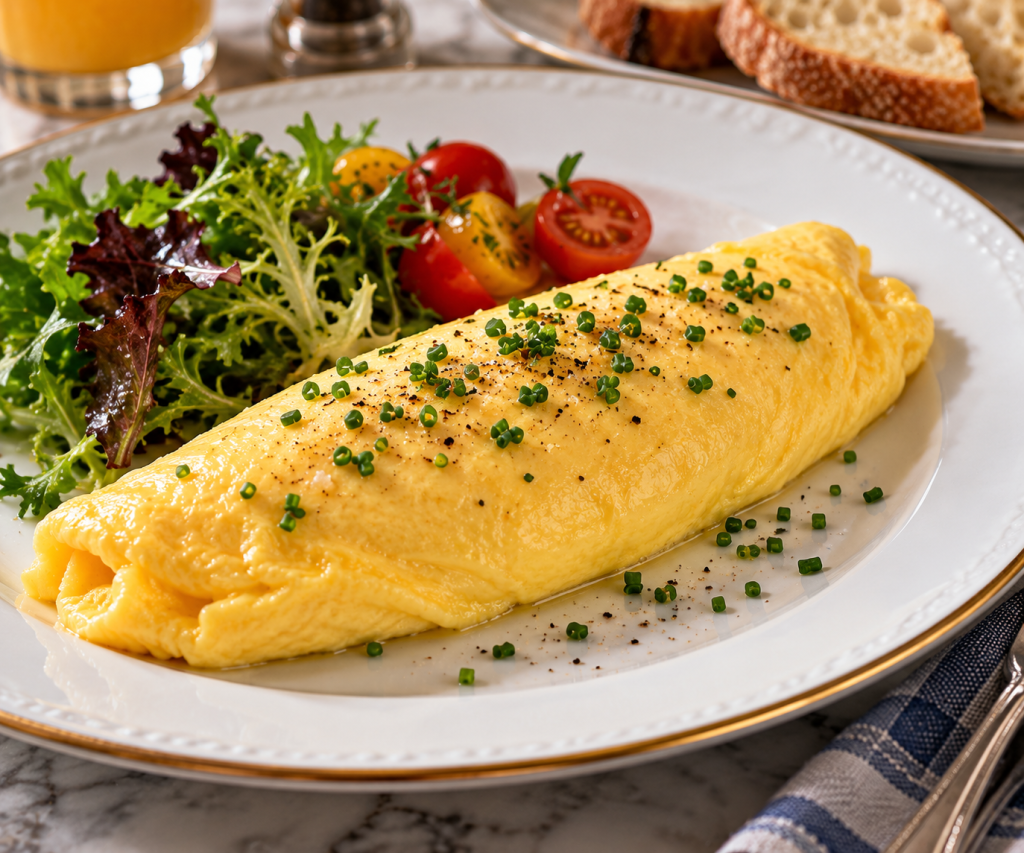
A classic French omelette is a study in simplicity and technique. Made with just eggs, butter, and a little seasoning, it features a smooth, pale golden exterior and a delicate, tender interior with soft, creamy curds. Unlike its American counterpart, a traditional French omelette is not browned or heavily filled. Instead, the eggs are gently stirred, shaped, and rolled into an elegant oval.
This version uses a controlled cooking technique that produces consistent results without sacrificing the delicate texture that makes a French omelette special. Serve it simply with fresh chives or finish with a small amount of Mornay, crème fraîche and fine herbs, or Parmesan cream sauce.
Servings: 1 omelette Prep Time: 5 minutes
Cook Time: 3–5 minutes Total Time: 10 minutes
Difficulty: Level 3 Moderate Cost: Level 1 Budget
Region / Ethnic Origin: France
Ingredients
3 large eggs
1 tablespoon unsalted butter, divided
1/8 teaspoon kosher salt, or to taste
1 pinch freshly ground white pepper
1 teaspoon finely chopped fresh chives, optional
Additional softened butter, for finishing, optional
Instructions
Prepare the Eggs
1. Crack the eggs into a medium mixing bowl. Add the kosher salt and white pepper.
2. Beat vigorously with a fork or whisk until the yolks and whites are completely combined and the mixture is uniform in color. Avoid incorporating excessive air.
3. For an exceptionally smooth omelette, pass the beaten eggs through a fine-mesh sieve into a clean bowl. This optional step removes any remaining strands of egg white.
Cook the Omelette
4. Place an 8-inch nonstick skillet over medium-low heat. Allow the skillet to warm gradually for approximately 1 minute.
5. Add 2 teaspoons of the butter and swirl to coat the bottom and sides of the skillet. The butter should melt and foam gently without browning.
6. Pour the beaten eggs into the center of the skillet.
7. Immediately begin stirring the eggs rapidly with a silicone spatula while gently shaking the skillet back and forth. Keep the eggs moving to form very small, soft curds.
8. As the eggs begin to thicken, reduce the heat to low. Continue stirring until the mixture resembles a soft, creamy scramble but remains moist and fluid enough to spread into an even layer.
9. Stop stirring and gently smooth the surface with the spatula. Allow the omelette to set for approximately 10–20 seconds, just until the bottom holds together while the upper surface remains slightly glossy. The eggs should not develop any browning.
Shape and Roll
10. Remove the skillet from the heat. Using the spatula, gently loosen the edges of the omelette.
11. Tilt the skillet slightly away from you. Fold the edge nearest the handle approximately one-third of the way toward the center.
12. Gently roll or fold the opposite edge toward the center, forming an elongated oval with the seam underneath.
13. Add the remaining teaspoon of butter near the edge of the skillet to help release the omelette.
14. Position a warm serving plate next to the skillet. Tilt the skillet and carefully roll the omelette onto the plate, seam-side down.
15. If desired, gently brush the surface with a small amount of softened butter to give it a subtle sheen.
16. Garnish with finely chopped chives and serve immediately.
Cook’s Notes
The right skillet: An 8-inch nonstick skillet with gently sloping sides is ideal for a three-egg French omelette. A well-seasoned carbon-steel omelette pan is another excellent choice.
Temperature control: The most important element is controlling the heat. The butter should foam without browning, and the eggs should cook gently enough to remain pale and tender.
Egg texture: The interior should be creamy and softly set, not liquid or runny. If preparing eggs for young children, pregnant individuals, older adults, or anyone with a weakened immune system, cook until fully set or use pasteurized eggs.
Continuous movement: Stirring the eggs while shaking the skillet produces the fine, delicate curds associated with a classic French omelette.
Avoid browning: A traditional French omelette should be uniformly pale yellow, without the golden-brown patches characteristic of an American omelette.
Practice makes perfect: Rolling an omelette takes practice. Concentrate first on achieving the correct texture and temperature; the shaping technique becomes easier with experience.
Serving temperature: Serve immediately on a warm plate. A French omelette loses its delicate texture when held for extended periods.
Serving Suggestions
A traditional French omelette is delicious with nothing more than fresh chives and a little butter, but carefully chosen accompaniments can turn it into an elegant breakfast, brunch, or light supper.
– Classic French Presentation: Serve with finely chopped chives, lightly buttered toast, and a small green salad dressed with a simple vinaigrette.
– Sauce Mornay: Spoon 1–2 tablespoons of Classic French Sauce Mornay alongside the omelette. The nutty Gruyère and Parmesan complement the tender eggs without overwhelming them.
– Crème Fraîche and Fine Herbs Sauce: Serve with a small amount of this delicate herb sauce for a fresh, lightly tangy finish.
– Light Parmesan and Crème Fraîche Sauce: Pair with sautéed mushrooms, asparagus, or wilted spinach and a spoonful of the warm sauce.
– French Bistro Breakfast: Accompany with roasted tomatoes, sautéed mushrooms, and a slice of toasted country bread.
– Elegant Brunch: Serve with lightly dressed arugula, tender asparagus, and fresh seasonal fruit.
Beverage Suggestions
Café au lait: Freshly brewed coffee combined with warm milk is a classic French breakfast accompaniment.
Fresh orange juice: Its bright acidity balances the richness of the eggs and butter.
Earl Grey tea: A delicate, aromatic alternative to coffee.
Dry sparkling wine: Champagne or Crémant de Bourgogne pairs beautifully with an elegant brunch.
Storage and Reheating
Best served fresh: A French omelette is at its best immediately after cooking. Refrigeration and reheating diminish its delicate, creamy texture.
Refrigeration: If necessary, refrigerate leftovers promptly in an airtight container at 40°F or below for up to 3–4 days.
Reheating: Gently reheat in a covered nonstick skillet over low heat until thoroughly heated to 165°F. The texture will be firmer than when freshly prepared.
Freezing: Not recommended.
Variations
Fines Herbes Omelette: Add 1 teaspoon each of finely chopped chives, chervil, parsley, and tarragon to the beaten eggs before cooking.
Gruyère Omelette: Sprinkle 1–2 tablespoons finely grated Gruyère over the eggs just before rolling.
Mushroom Omelette: Add 2 tablespoons finely chopped, thoroughly sautéed mushrooms to the center before folding.
Ham and Cheese Omelette: Add 1 tablespoon finely diced cooked ham and 1 tablespoon finely grated Gruyère before rolling.
Truffle Omelette: Finish with a few thin shavings of fresh truffle or a few drops of truffle oil.
Once


Leave a Reply