
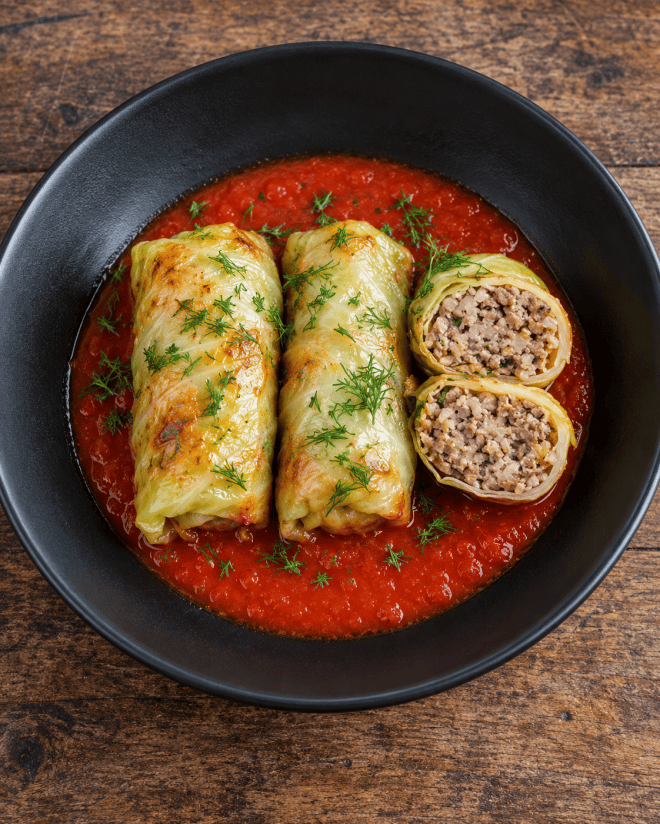
Tender cabbage leaves are wrapped around a deeply savory filling of beef, pork, partially cooked rice, butter-softened bread, onion, garlic, marjoram, and oregano. The rolls are gently braised until tender, then browned in butter for added flavor and served over a concentrated tomato sauce.
This version keeps the traditional character of Polish gołąbki while adding a restaurant-style finishing step that gives the cabbage rolls lightly caramelized edges and a more polished presentation.
Prep Time: 1 hour
Cook Time: 1 hour 30 minutes
Total Time: 2 hours 30 minutes
Servings: 8, about 2 cabbage rolls each
Difficulty: Level 3 – Moderate
Cost: Level 3 – Moderate
Cuisine & Region: Polish
Ingredients
For the Filling
- 1/3 cup long-grain white rice
- 2/3 cup water
- 5 tablespoons unsalted butter, divided
- 1 medium yellow onion, finely diced
- 4 garlic cloves, finely minced
- 2 slices white or artisan bread, crusts removed and cut into small cubes
- 1 pound ground beef, preferably 85 percent lean
- 1 pound ground pork
- 1 1/2 teaspoons dried marjoram
- 1 1/2 teaspoons dried oregano
- 1/2 teaspoon sweet paprika
- 1 1/2 teaspoons kosher salt, plus more as needed
- 1/2 teaspoon freshly ground black pepper
For the Cabbage Rolls
- 1 large young green cabbage
- 4 cups low-sodium beef stock
- 2 tablespoons tomato paste
- 2 tablespoons unsalted butter, for browning the finished rolls
For the Tomato Sauce
- 1 can tomato puree, 28 ounces
- Reserved cabbage-roll braising liquid
- 1 bay leaf
- 1/16 teaspoon ground allspice
- 2 tablespoons unsalted butter
- 1 teaspoon red wine vinegar
- Kosher salt, to taste
- Freshly ground black pepper, to taste
For Serving
- Fresh dill, finely chopped
- Sour cream, optional
Instructions
Prepare the Rice
- Add the rice to a small saucepan and cook over low heat for 3 to 4 minutes, stirring constantly, until the grains look slightly opaque and milky.
- Add the water and a small pinch of salt. Stir once, cover, and cook over low heat for 8 minutes.
- Remove from the heat and spread the rice on a plate or shallow pan to cool completely. The rice should still be slightly undercooked.
Prepare the Bread and Onion Mixture
- Melt 3 tablespoons of the butter in a large skillet over medium heat.
- Add the onion and a light pinch of salt. Cook for about 5 minutes, until softened and beginning to brown.
- Reduce the heat to low and continue cooking for about 10 minutes, stirring occasionally, until the onion is golden and lightly caramelized.
- Add the garlic and cook for 30 to 45 seconds, just until fragrant.
- Add the diced bread directly to the skillet.
- Toss the bread thoroughly with the butter, onion, and garlic until it is evenly coated and softened.
- Remove from the heat and let the bread mixture cool for about 10 minutes.
Make the Filling
- Combine the cooled rice, bread-and-onion mixture, ground beef, ground pork, marjoram, oregano, paprika, salt, and black pepper in a large bowl.
- Mix gently with your hands just until evenly combined. Do not compact or overwork the mixture.
- Cook a tablespoon of the filling in a small skillet. Taste and adjust the seasoning in the remaining filling if necessary.
Prepare the Cabbage
- Bring a large stockpot of generously salted water to a boil.
- Carefully remove the core from the cabbage, reserving the core and any loose leaves.
- Lower the cabbage into the boiling water and cook for 3 to 4 minutes per side.
- Remove the cabbage and let cool just until it can be handled safely.
- Carefully peel away the softened outer leaves without tearing them. Return the cabbage to the boiling water for another 2 to 3 minutes whenever the inner leaves become difficult to remove.
- Continue until you have 16 to 18 usable cabbage leaves.
- Lay each leaf flat and shave down the thick center rib with a paring knife so the leaf rolls easily.
Assemble the Gołąbki
- Cut the remaining cabbage heart into wedges.
- Arrange the cabbage wedges, core, and unused leaves over the bottom of a large Dutch oven or deep heavy pot.
- Place 2 to 4 ounces of filling near the lower third of one cabbage leaf.
- Fold the bottom of the leaf over the filling, fold in both sides, then roll snugly toward the tip.
- Arrange the roll seam-side down over the cabbage-lined bottom of the pot.
- Repeat with the remaining leaves and filling, layering the rolls snugly.
Braise the Cabbage Rolls
- Whisk the beef stock and tomato paste together until smooth.
- Pour the mixture around the cabbage rolls.
- Bring to a boil over high heat.
- Cover, reduce the heat to low, and gently simmer for 50 to 60 minutes, or until the cabbage is tender and the filling is cooked through.
- Carefully transfer the cabbage rolls to a platter and cover loosely to keep warm.
- Strain the braising liquid into a saucepan and reserve it for the sauce.
Make the Tomato Sauce
- Add the tomato puree, bay leaf, allspice, and a pinch of salt to the reserved braising liquid.
- Bring to a steady simmer over medium-high heat.
- Cook for about 15 minutes, stirring frequently, until the sauce has reduced by approximately 25 percent and the flavor has concentrated.
- Remove the bay leaf.
- Stir in the butter and red wine vinegar.
- Taste and season with salt and black pepper as needed.
Brown the Cabbage Rolls
- Melt the remaining 2 tablespoons butter in a large skillet over medium to medium-high heat.
- Working in batches, place the braised cabbage rolls seam-side down in the skillet.
- Cook for 2 to 3 minutes without moving, until the underside is lightly browned.
- Turn carefully and brown one additional side for 1 to 2 minutes.
- Remove from the skillet as soon as the cabbage develops golden-brown patches. Do not overcook or crisp the leaves; the goal is light caramelization while the cabbage remains tender.
Plate and Serve
- Spoon a generous but shallow pool of warm tomato sauce onto each plate.
- Place 2 cabbage rolls over the sauce, slightly overlapping rather than stacked.
- For the most attractive presentation, leave one roll whole and cut the second roll cleanly in half crosswise to expose the meat-and-rice filling.
- Position the cut halves with the filling facing upward.
- Spoon only a small amount of additional sauce around the rolls rather than covering the cabbage completely. The browned cabbage should remain visible.
- Finish with a light scattering of finely chopped fresh dill.
- Serve sour cream on the side or as a small spoonful beside the rolls rather than directly over them.
Cook’s Notes
Bread treatment matters. Add the bread directly to the butter-softened onion and garlic mixture. It absorbs the seasoned butter and onion juices, producing a moist, tender filling while preserving a more cohesive texture than a milk-soaked panade.
Toast the rice before adding water. The brief dry-toasting step develops subtle nuttiness and helps keep the grains distinct after braising.
Do not completely cook the rice before adding it to the meat. It finishes cooking inside the cabbage rolls and absorbs the flavorful juices released during braising.
Young green cabbage is easiest to work with because the leaves tend to be thinner, more flexible, and less tightly packed.
The unused cabbage at the bottom of the pot creates a natural protective layer that helps prevent the rolls from sticking or scorching.
Do not skip the final browning if presentation matters. Butter-browning gives the pale braised cabbage attractive golden patches and adds a subtle nutty flavor.
Brown only after braising. Browning raw assembled rolls first makes them more difficult to handle and increases the chance of tearing the cabbage.
When cutting a roll for presentation, use a very sharp knife and make one decisive cut rather than sawing through it. This keeps the filling compact and exposes a clean cross-section.
Serving Suggestions
Serve with Rye Bread for soaking up the tomato sauce. Your rye bread includes caraway, which is especially compatible with the cabbage and pork in the gołąbki.
Sweet Cucumber Salad is an especially good side because its vinegar, cucumber, red onion, and optional dill provide a cool, acidic contrast to the rich filling and tomato sauce.
Boiled buttered potatoes or creamy mashed potatoes also work well for a more substantial meal.
Beverage Suggestions
A dry Riesling is particularly good here because its acidity cuts through the pork and beef while complementing the sweet cabbage and tomato.
A clean Polish or European-style lager provides a crisp contrast without competing with the marjoram and cabbage.
Pinot Noir works well when a red wine is preferred because it has sufficient acidity for the tomato sauce without excessive tannin.
For a nonalcoholic option, serve chilled sparkling apple cider or unsweetened black tea.
Storage and Reheating
Store the cabbage rolls and tomato sauce separately in airtight containers in the refrigerator for up to 4 days.
Freeze the rolls and sauce separately for up to 3 months.
Thaw overnight in the refrigerator before reheating.
For the best reheated texture, place the cabbage rolls in a covered baking dish with a small amount of sauce and heat at 350°F for 20 to 25 minutes.
For a freshly browned finish, reheat the rolls first, then brown them briefly in butter immediately before serving.
Variations
Barley Gołąbki
Replace the rice with 1/4 cup pearl barley cooked with 3/4 cup water until slightly underdone.
Mushroom Sauce Gołąbki
Replace the tomato sauce with a creamy mushroom sauce for a more earthy, traditional variation.
All-Beef Gołąbki
Replace the pork with an additional pound of ground beef.
Savoy Cabbage Gołąbki
Substitute Savoy cabbage for green cabbage. Its thinner leaves are particularly easy to roll and become very tender during braising.


Leave a Reply