
Crispy French Potato Cake with Garlic, Thyme & Beef Tallow
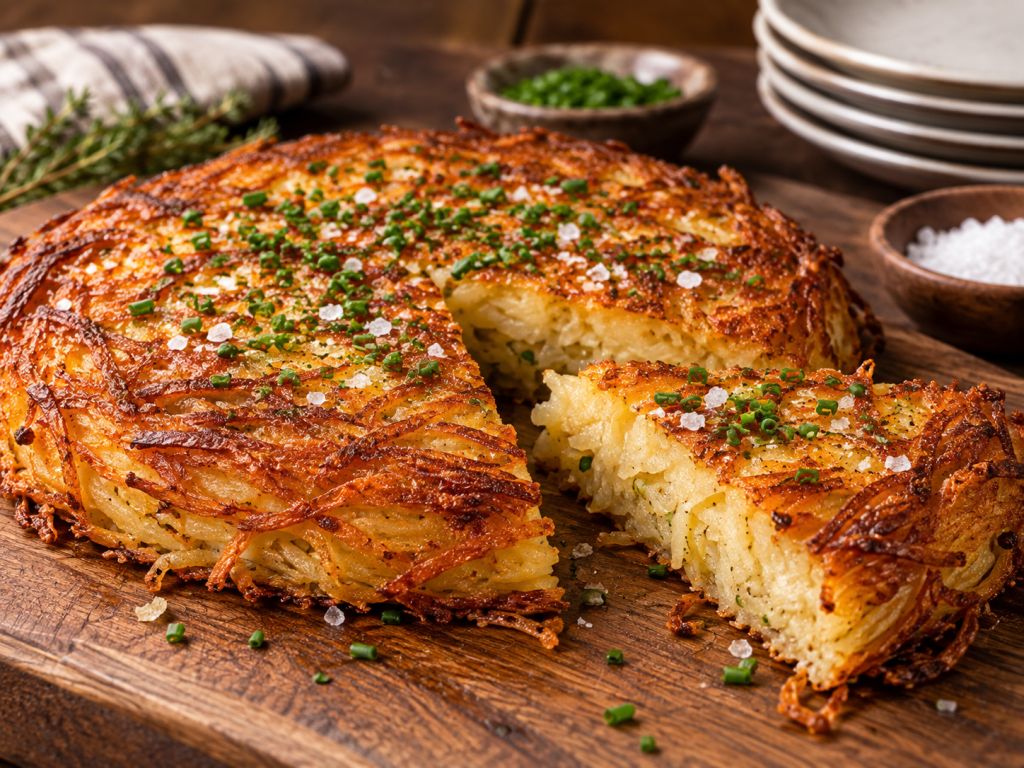
Pomme Paillasson is a classic French potato preparation made from fine matchsticks of potato pressed into a single cake and slowly cooked until deeply golden and exceptionally crisp outside while remaining tender within. Its name comes from the French word paillasson, meaning “straw mat,” a reference to the interwoven appearance of the crisp potato strands.
This version uses garlic-infused beef tallow for savory richness, fresh thyme for an aromatic note, and chives and flaky sea salt for a simple finish. The potatoes are deliberately left unrinsed so their natural surface starch helps bind the strands without flour or egg.
The Control Freak method is preferred because precise pan-temperature control makes it easier to develop an evenly browned crust without overcooking the exterior before the center becomes tender. Conventional stovetop instructions are included as an alternative.
Prep Time: 20 minutes
Cook Time: 30–40 minutes
Total Time: 50–60 minutes
Servings: 6
Difficulty: Level 3 — Moderate
Cost: Level 2 — Economical
Ingredients
- 2 pounds Agria or russet potatoes
- 3 1/2 tablespoons beef tallow, divided, plus more as needed
- 3 garlic cloves, peeled and lightly crushed
- 2 teaspoons fresh thyme leaves
- 1 teaspoon fine sea salt
- 1/2 teaspoon freshly ground black pepper
- 1 tablespoon finely sliced fresh chives
- Flaky sea salt, for finishing
Instructions
Prepare the Potatoes
- Peel the potatoes. Using a mandoline, slice them lengthwise approximately 1/16 inch (2 millimeters) thick.
- Stack several slices at a time and cut them lengthwise into approximately 1/16-inch matchsticks. Work quickly to minimize oxidation.
- Transfer the potatoes directly to a large mixing bowl. Do not rinse, soak, or squeeze them. Their natural surface starch is essential for helping the individual strands bind into a cohesive cake.
Infuse the Beef Tallow
- Combine 3 tablespoons beef tallow and the crushed garlic in a small saucepan over low heat.
- Gently heat the tallow to approximately 158°F, about 4–5 minutes. The garlic should become fragrant but should not brown.
- Remove and discard the garlic.
- Immediately pour the warm garlic-infused tallow over the potatoes. Toss thoroughly, separating the strands so the tallow coats them evenly.
- Add the thyme, fine sea salt, and black pepper. Toss until evenly distributed.
Preferred Control Freak Method
- Spread the remaining 1/2 tablespoon beef tallow across the bottom of a cold 9-inch induction-compatible nonstick skillet.
- Add the seasoned potatoes to the cold skillet. Distribute them evenly and press firmly with a wide silicone spatula to create a compact cake approximately 1–1 1/4 inches thick.
- Tuck loose strands around the perimeter inward and underneath to create a neat circular edge. Press the surface again so the cake has uniform thickness.
- Place the skillet on the Control Freak. Select Pan Control and set the temperature to 310°F. Allow the skillet and potatoes to heat together from cold.
- Once the pan reaches 310°F, continue cooking at 310°F for approximately 10–15 minutes, until the underside develops a deep, even golden-brown crust.
- During cooking, occasionally press the perimeter gently inward to maintain the cake’s shape. Avoid repeatedly lifting or disturbing the potatoes while the crust develops.
- Test the cake by gently shaking the skillet. When properly set, it should move as a single cohesive piece.
- Carefully lift one edge with a thin silicone spatula. The underside should be deep golden brown and crisp, not merely pale gold. Continue cooking if necessary.
- Place a flat plate slightly larger than the skillet over the pan. Holding the plate securely against the skillet, carefully invert the skillet and plate together in one controlled motion.
- Return the skillet to the Control Freak. If the surface appears dry, add 1–2 teaspoons beef tallow and distribute it across the pan.
- Carefully slide the potato cake back into the skillet with the browned side facing upward.
- Continue cooking at 310°F for 10–15 minutes, until the second side is deeply golden and crisp.
- Insert a thin knife or metal skewer into the center. It should pass through the potatoes easily with very little resistance.
- If both surfaces are sufficiently browned but the center isn’t completely tender, reduce the Control Freak to 285°F and continue cooking for 3–8 minutes, checking periodically, until the center is tender.
- Transfer the finished pomme paillasson to a wire rack set over a sheet pan. Let stand for 1–2 minutes to allow excess surface fat and steam to escape without softening the crust.
- Transfer to a warm serving platter or cutting board. Scatter the chives over the top and finish with flaky sea salt.
- Cut into wedges with a sharp knife and serve immediately.
Conventional Stovetop Method
- If not using a Control Freak, place a 9-inch nonstick or exceptionally well-seasoned cast-iron skillet over medium-low heat. Add the remaining 1/2 tablespoon beef tallow.
- When the tallow is hot but not smoking, add the potato mixture. Distribute it evenly and press firmly into a compact cake approximately 1–1 1/4 inches thick.
- Cook over medium-low heat for 12–18 minutes, occasionally rotating the skillet to compensate for hot spots. Adjust the heat as necessary to encourage steady browning without scorching.
- When the underside is deeply golden and the cake moves as a single piece, invert it onto a plate.
- Add another 1–2 teaspoons beef tallow if the skillet appears dry, then carefully slide the cake back into the skillet with the browned side facing upward.
- Cook the second side over medium-low heat for another 10–15 minutes, until deeply golden and crisp.
- Check the center with a thin knife or skewer. If the exterior is sufficiently browned before the center is completely tender, reduce the heat to low and continue cooking until the potatoes are tender.
- Transfer to a wire rack for 1–2 minutes, then finish with chives and flaky sea salt and serve immediately.
Cook’s Notes
Control Freak: The preferred method uses Pan Control at 310°F with a cold start. Precise surface-temperature control encourages gradual binding of the potato strands followed by controlled browning. If the crust finishes before the center, reducing the temperature to 285°F allows the interior to finish with less additional browning.
Use Pan Control, not the probe: The critical variable is the temperature at the cooking surface. A probe inserted into the potato cake is unnecessary for the primary cooking process.
Potato selection: Agria potatoes are ideal when available. Russet potatoes are the preferred readily available substitute because their relatively high starch and lower moisture encourage both cohesion and crispness.
Do not rinse: The cloudy starch normally washed away when preparing potatoes is useful here. It acts as the natural binder holding the fine potato strands together.
Julienne rather than grate: Cutting the potatoes into fine matchsticks preserves distinct strands and creates the characteristic woven appearance. The exposed edges also become exceptionally crisp.
Uniformity matters: A mandoline followed by careful julienning produces much better results than irregular hand-cut pieces.
Thickness matters: Keep the finished cake approximately 1–1 1/4 inches thick. A substantially thicker cake risks developing an overly dark exterior before its center becomes tender.
Infuse the garlic: Garlic cloves flavor the warm tallow and are then removed. Adding minced garlic directly to the potatoes risks creating bitter, burned garlic during the extended cooking time.
Don’t rush the flip: Color and structure are more important than the clock. The first surface should be deeply golden and the cake should move cohesively before turning.
Use a plate to flip: A plate provides much better support than trying to turn a large potato cake with a spatula.
Rest briefly: The 1–2-minute rack rest allows escaping steam to dissipate without becoming trapped underneath the potato cake and softening its crust.
Serve immediately: Pomme paillasson is at its best when there is a pronounced contrast between the crisp exterior and piping-hot tender center.
Serving Suggestions
Serve Pomme Paillasson as an elegant alternative to roasted or mashed potatoes alongside steak, beef tenderloin, roast beef, roast chicken, pork tenderloin, duck, or roasted fish.
For a French-inspired meal, pair it with steak and a green salad dressed with a sharp Dijon vinaigrette. The acidity provides an excellent counterpoint to the rich beef tallow and crisp potatoes.
For brunch, serve wedges with poached or fried eggs and lightly dressed greens.
For the most attractive presentation, bring the potato cake to the table whole on a warmed platter. Scatter the chives and flaky sea salt over the deeply browned surface immediately before cutting it into wedges.
Beverage Suggestions
With steak, beef tenderloin, or roast beef, pair with Cabernet Sauvignon, Syrah, or a Bordeaux-style red.
With poultry, pork, or fish, serve a dry Chardonnay, Sauvignon Blanc, or dry sparkling wine.
For a nonalcoholic pairing, sparkling mineral water with lemon provides acidity and carbonation that balance the richness. A tart sparkling apple beverage is another excellent choice.
Storage and Reheating
Refrigerate leftovers in an airtight container for up to 3 days.
For the best texture, place wedges on a wire rack set over a sheet pan and reheat in a 400°F oven for 8–12 minutes, until thoroughly hot and crisp.
Alternatively, reheat in an air fryer at 375°F for 5–7 minutes.
Avoid reheating in the microwave when possible because trapped steam quickly softens the crisp potato crust.
Variations
Duck-Fat Pomme Paillasson
Replace the beef tallow with an equal amount of duck fat for an especially rich version that pairs beautifully with duck, chicken, or pork.
Clarified-Butter Pomme Paillasson
Replace the beef tallow with clarified butter for a more delicate buttery character. Clarified butter is preferable to whole butter because its milk solids have been removed, reducing the risk of scorching during the prolonged cooking.
Rosemary and Garlic Pomme Paillasson
Replace the thyme with 1 teaspoon finely chopped fresh rosemary. Keep the garlic-infusion technique rather than adding minced garlic directly to the potatoes.
Individual Pomme Paillassons
Divide the mixture among small nonstick skillets or cooking rings to make individual potato cakes. Reduce the cooking time accordingly and judge doneness primarily by crust color and center tenderness.


Leave a Reply