
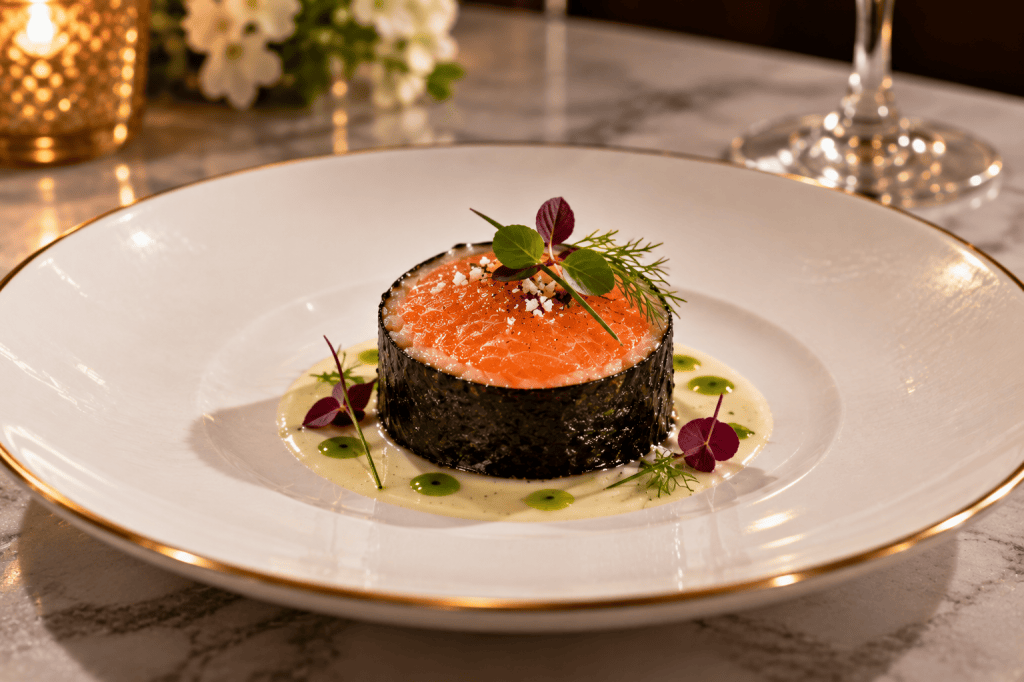
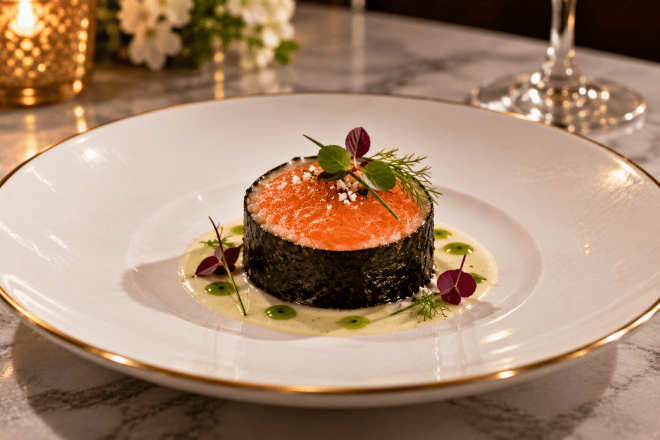
Silky, delicately cooked salmon is formed into an elegant cylinder and cooked sous vide at an exceptionally low temperature to preserve its rosy color and luxurious, almost custard-like texture. After cooking, the salmon is wrapped in nori and sliced into striking rounds, combining classic French mi-cuit technique with Japanese flavors in a refined French-Japanese fusion dish.
Servings: 4
Prep Time: 30 minutes, plus 1 hour chilling
Cook Time: 70 minutes
Total Time: 2 hours 40 minutes
Difficulty: Level 4 Advanced
Cost: Level 4 Premium
Region / Ethnic Origin: French-Japanese Fusion
Ingredients
Salmon
- 1 1/2 pounds center-cut skinless salmon fillet, pin bones removed
- 1 1/2 teaspoons fine sea salt
- 1/2 teaspoon granulated sugar
- Freshly ground white pepper, to taste
- 1 teaspoon transglutaminase, optional, for bonding the salmon into a seamless cylinder
Nori Wrap
- 1 to 2 sheets toasted nori, as needed
- Cold water, as needed for sealing
For Finishing
- Flaky sea salt, to taste
- Extra-virgin olive oil, as needed
- Fresh lemon juice, to taste
Instructions
Prepare and Shape the Salmon
- Inspect the salmon carefully and remove any remaining pin bones. Trim away the thin belly portion, dark bloodline, connective tissue, and irregular edges.
- Cut the salmon lengthwise into long, relatively even pieces that can be assembled into a uniform cylinder.
- Combine the fine sea salt and sugar. Season the salmon evenly with the mixture and a restrained amount of white pepper.
- If using transglutaminase, lightly and evenly dust the surfaces of the salmon that will contact one another. Use only enough to create a secure bond.
- Arrange the pieces lengthwise, positioning thicker and thinner portions together to create a log of even thickness.
- Place the assembled salmon on food-safe plastic wrap suitable for use at the cooking temperature. Roll the salmon very tightly in the plastic wrap, twisting the ends firmly in opposite directions to compress it into a smooth cylinder approximately 2 inches in diameter.
- Refrigerate for about 1 hour, or until the cylinder is firm. If using transglutaminase, follow the manufacturer’s recommended refrigerated bonding time.
Cook Sous Vide
- Preheat a sous vide water bath to 108°F (42°C).
- Leave the salmon tightly enclosed in the plastic wrap and place the entire wrapped cylinder into a sous vide bag.
- Vacuum-seal using enough pressure to remove the air without flattening or distorting the cylinder.
- Completely submerge the bag in the water bath and cook at 108°F (42°C) for 70 minutes.
- Remove the bag from the water bath and take out the plastic-wrapped salmon.
- Carefully remove the plastic wrap without damaging the delicate cylinder. Gently blot the exterior completely dry with paper towels.
- Refrigerate the salmon briefly, just until cool and sufficiently firm to wrap and slice cleanly. Do not thoroughly chill it unless preparing it in advance.
Wrap with Nori
- Place a sheet of nori rough-side up on a clean work surface.
- Position the cooked salmon cylinder along one edge and roll the nori snugly around the salmon.
- Trim away excess nori, leaving only a slight overlap. Very lightly moisten the overlapping edge with cold water and seal.
- Place the cylinder seam-side down for several minutes to allow the nori to adhere.
Slice and Serve
- Using a very sharp, thin-bladed knife, cut the nori-wrapped salmon crosswise into thick, even rounds. Wipe the blade clean between every cut to keep the nori sharply defined.
- Allow the portions to stand briefly after slicing so they lose their refrigerator chill. For the best flavor and texture, serve the salmon cool rather than refrigerator-cold, approximately 55–60°F.
- Arrange the portions cut-side up to showcase the rosy salmon surrounded by the dark nori. Finish sparingly with flaky sea salt, a few drops of extra-virgin olive oil, and fresh lemon juice. Serve promptly.
Cook’s Notes
Mi-cuit texture: Mi-cuit translates as “half-cooked.” At 108°F, the salmon remains rosy and translucent rather than becoming firm, opaque, and flaky. The unusually low temperature is essential to the silky texture that defines this preparation.
Keep the plastic wrap on during cooking: The tightly wrapped cylinder goes directly into the vacuum bag. The plastic wrap maintains compression and helps preserve the salmon’s round shape during vacuum sealing and cooking. Use only food-safe plastic wrap that the manufacturer indicates is suitable for use at the cooking temperature.
Add the nori after cooking: Applying the nori after sous vide cooking prevents prolonged exposure to moisture and heat and produces a cleaner, more distinct dark border around each slice.
Transglutaminase: Transglutaminase provides the cleanest result when several pieces of salmon are assembled into a seamless cylinder. Follow the manufacturer’s quantity, handling, and refrigerated bonding instructions.
Do not sear: Searing would create an opaque, conventionally cooked exterior and eliminate the uniform mi-cuit texture.
Serving temperature: Brief chilling makes the extremely tender salmon easier to wrap and slice, but it should not be served refrigerator-cold. Allow the portions to temper to approximately 55–60°F before serving.
Food safety: The 108°F for 70 minutes cooking method is designed for texture and does not pasteurize the salmon. Use salmon appropriate for raw or lightly cooked preparations and observe careful cold-chain, handling, and sanitation practices. When applicable, use fish that has undergone appropriate parasite-destruction freezing. This preparation is not appropriate for people who have been advised to avoid raw or undercooked seafood.
For a pasteurized alternative: Pasteurizing salmon requires substantially higher temperatures and/or much longer cooking. That changes the characteristic mi-cuit texture, so it is better treated as a different preparation rather than altering this recipe.
Serving Suggestions
Serve the salmon with fresh, acidic accompaniments that balance its richness without obscuring its delicate texture. Shaved cucumber, lightly pickled cucumber or daikon, asparagus, tender greens, or a small citrus-dressed salad are particularly suitable.
For a more composed presentation, accompany each portion with a restrained amount of ponzu-style citrus sauce, citrus vinaigrette, or light beurre blanc. Place the sauce beneath or alongside the salmon rather than over it so the nori-wrapped presentation remains visible.
Beverage Suggestions
For a nonalcoholic pairing, serve chilled sparkling mineral water with lemon or cucumber, unsweetened green tea, or a lightly sweetened citrus-and-elderflower spritzer.
For wine, choose a mineral-driven Chablis, Sancerre, dry Champagne, or another restrained sparkling wine. A crisp, dry sake also pairs particularly well with the salmon and nori.
Dessert Suggestions
Follow the rich, silky salmon with something fresh and relatively light. Lemon or yuzu sorbet provides the cleanest finish, while lemon posset, a restrained lemon tart, or fresh berries with lightly sweetened crème fraîche would make an elegant conclusion.
For a dessert that continues the French-Japanese fusion theme, a delicate matcha panna cotta or matcha crème brûlée would also pair well.


Leave a Reply