
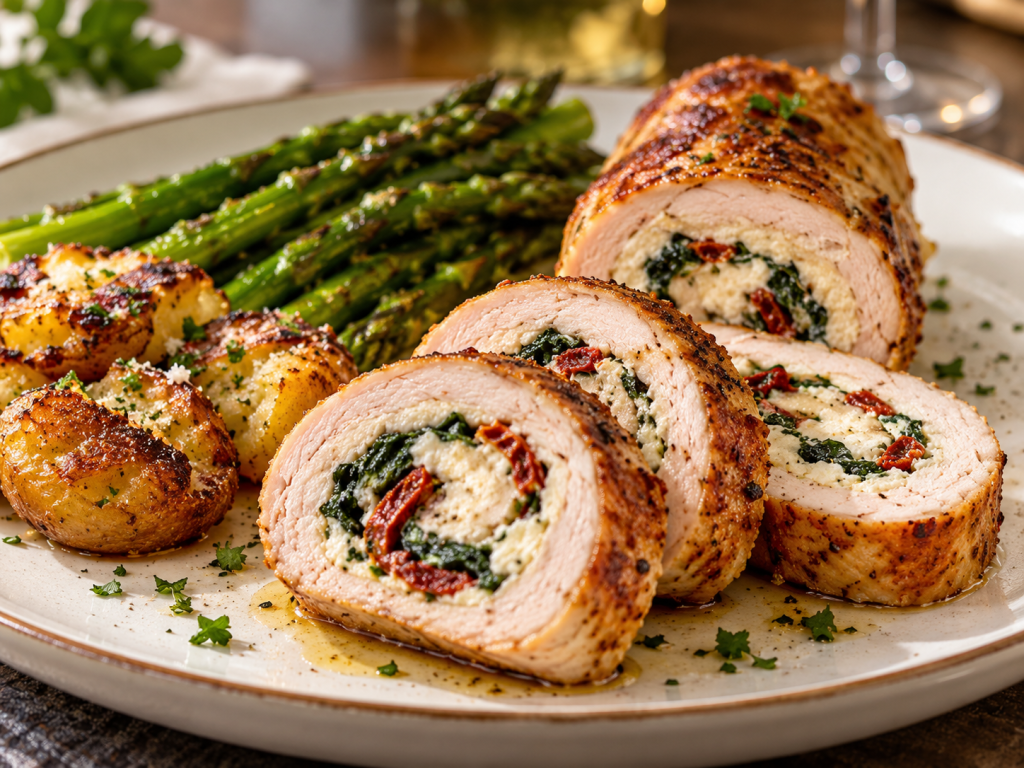
Sous Vide Turkey Roulade with Ricotta, Spinach & Sun-Dried Tomatoes
Tender turkey breast is rolled around creamy ricotta, Parmesan, fresh spinach, and savory sun-dried tomatoes, then cooked gently sous vide for exceptionally moist, evenly cooked meat. A quick sear creates a deeply golden exterior while preserving the colorful spiral within. Sliced into thick medallions, it makes an elegant main course suitable for entertaining as well as a special family dinner.
Servings: 4
Prep Time: 30 minutes
Cook Time: 2 hours 45 minutes
Total Time: 3 hours 15 minutes
Difficulty: Level 3 Moderate
Cost: Level 3 Moderate
Region / Ethnic Origin: Contemporary European / Italian-inspired
Ingredients
Turkey Roulade
- 1 2/3 pounds (740 grams) boneless, skinless turkey breast fillet
- 1 teaspoon kosher salt
- 1/2 teaspoon freshly ground black pepper
- 1 tablespoon olive oil, for searing
Ricotta, Spinach & Sun-Dried Tomato Filling
- 9 ounces (250 grams) whole-milk ricotta cheese
- 1 ounce (30 grams) Parmesan cheese, finely grated
- 3 ounces (80 grams) baby spinach
- 3 to 4 oil-packed sun-dried tomatoes, thoroughly drained and thinly sliced
- 1/4 teaspoon kosher salt
- 1/4 teaspoon freshly ground black pepper
Instructions
Prepare the Turkey
- Preheat the sous vide water bath to 145°F (62.8°C).
- Butterfly the turkey breast lengthwise without cutting completely through. Open it like a book.
- Place the turkey between sheets of plastic wrap and gently pound it to an even thickness of approximately 1/3 inch, or 7 to 8 millimeters. Shape it into as even a rectangle as possible without tearing the meat.
- Season the turkey evenly with the salt and black pepper.
Prepare the Filling
- Place the ricotta in a fine-mesh strainer and allow any excess liquid to drain. Particularly wet ricotta can be refrigerated in the strainer for 20 to 30 minutes.
- Combine the drained ricotta and Parmesan. Season with the salt and black pepper.
- Spread the ricotta mixture evenly over the turkey, leaving approximately a 1-inch border around the edges.
- Distribute the baby spinach evenly over the ricotta.
- Scatter the sliced sun-dried tomatoes evenly over the spinach.
Form the Roulade
- Starting from one long side, roll the turkey firmly around the filling, keeping the cylinder compact without squeezing the filling from the ends.
- Place the roulade on a large sheet of heat-safe plastic wrap. Roll it tightly, then twist the ends of the plastic in opposite directions to compress the turkey into a firm, evenly shaped cylinder.
- Add a second layer of heat-safe plastic wrap if necessary to maintain the shape. Secure the ends with kitchen twine.
- Place the roulade, still enclosed in the plastic wrap, inside a vacuum bag.
- Vacuum-seal the bag. Keeping the plastic wrap in place protects the shape of the roulade and prevents the vacuum from distorting the filling.
Cook Sous Vide
- Completely submerge the sealed roulade in the 145°F water bath.
- Cook for 2 hours 30 minutes.
- Remove the roulade from the water bath and cut open the vacuum bag.
- Carefully remove and discard the plastic wrap and kitchen twine.
- Pat the entire exterior of the roulade extremely dry with paper towels. A dry surface is essential for rapid browning without overcooking the turkey.
Sear & Serve
- Heat a heavy skillet, preferably cast iron, over high heat until very hot.
- Add the olive oil, followed immediately by the roulade.
- Sear for approximately 30 to 45 seconds per side, rotating the roulade with tongs until the entire exterior is deeply golden brown. Keep the searing time brief because the turkey is already cooked.
- Transfer to a cutting board and rest for 5 minutes.
- Using a very sharp knife, slice crosswise into approximately 1-inch-thick medallions.
- Serve immediately.
Cook’s Notes
Sous vide temperature: At 145°F, turkey breast remains substantially juicier than when cooked to the instantaneous 165°F endpoint commonly used for conventionally prepared poultry. Sous vide safety relies on the combination of temperature and sufficient holding time rather than temperature alone.
Roulade diameter: Cooking time depends substantially on thickness. Aim for a uniform cylinder approximately 2 1/2 to 3 inches in diameter. A significantly thicker roulade requires additional cooking time.
Use heat-safe plastic wrap: Use plastic wrap specifically suitable for cooking temperatures. It provides structure while the outer vacuum bag supplies the watertight sous vide barrier.
Drain the ricotta: Removing excess whey produces a firmer filling and cleaner spiral when the roulade is sliced.
Drain the sun-dried tomatoes: Blot oil-packed tomatoes thoroughly before slicing. Excess oil between the layers can cause the filling to slip away from the turkey when sliced.
Keep the spinach raw: The fresh spinach wilts sufficiently during sous vide cooking. Pre-cooking isn’t necessary.
For exceptionally clean slices: After sous vide cooking, leave the roulade sealed and place it in an ice bath for approximately 10 minutes. This firms both the turkey and filling. Unwrap, dry thoroughly, and sear before slicing.
Don’t skip the sear: Sous vide provides excellent texture but virtually no surface browning. A very hot, very brief sear provides the roasted flavor and golden exterior without sacrificing the precisely cooked interior.
Make ahead: After sous vide cooking, immediately transfer the sealed roulade to an ice bath and chill thoroughly. Refrigerate until needed. Reheat sous vide at 140°F, then unwrap, dry, and sear immediately before serving.
Serving Suggestions
Roasted Asparagus: The simple butter-and-chive asparagus included with this recipe is my first choice. Its clean flavor and slight vegetal bitterness provide contrast to the creamy ricotta and Parmesan without competing with the roulade.
Fried Smashed Potatoes: Crisp-edged red potatoes finished with Parmesan and Italian parsley make an excellent starch for a more substantial dinner. The crisp texture provides a particularly good counterpoint to the tender turkey and creamy filling.
Tuscan Cheese Potato Bake: For a richer dinner, this combination of red potatoes, garlic, thyme, buttermilk, Fontina, Parmesan, and blue cheese carries the Italian-inspired flavors through the entire plate. Because both dishes contain cheese, serve a relatively modest portion alongside the roulade.
Lebanese Lemon Garlic Potato Salad: For a brighter alternative, the lemon and garlic provide acidity that cuts through the ricotta filling. Despite its different regional influence, its flavor profile complements the turkey particularly well.
For an elegant plated dinner: Arrange 2 or 3 roulade medallions slightly overlapping on each warmed plate with a small portion of roasted asparagus and either the smashed potatoes or potato salad. Keep any sauce beneath or beside the turkey rather than over it so the spinach, ricotta, and sun-dried tomato spiral remains visible.
Beverage Suggestions
Agave Lemonade: The fresh lemon acidity is an especially good nonalcoholic counterpoint to the ricotta and Parmesan and won’t overwhelm the relatively delicate turkey.
Ginger, Lemon & Honey Tea: Serve it chilled over ice for this meal. Lemon provides brightness while the ginger adds enough character to stand alongside the sun-dried tomatoes without dominating the turkey.
Wine: Pinot Grigio, Soave, Sauvignon Blanc, or an unoaked Chardonnay would all complement the creamy filling. A lighter Pinot Noir is a suitable red-wine alternative.
Sparkling wine: A dry Prosecco or other dry sparkling wine provides acidity and carbonation that cleanse the palate particularly well between bites of the ricotta-filled turkey.
Storage and Reheating
Refrigerator: Store leftovers in an airtight container for up to 3 days.
Sous vide reheating: For the best texture, vacuum-seal the remaining roulade or individual portions and warm gently at 140°F until heated through.
Oven reheating: Cover loosely and warm in a 300°F oven just until heated through. Avoid prolonged reheating, which can dry the turkey and cause the ricotta filling to separate.
Freezing: Freezing isn’t preferred. Although the turkey freezes reasonably well, ricotta can develop a slightly grainy texture after thawing.


Leave a Reply